



Despite working in the finance industry for 16-plus years (as a writer), math is decidedly not my strong suit.
However, two things recently happened that made me want to dig into the numbers around padel in the U.S. a bit and try to determine at what point the market might become oversaturated with courts.
First off, I wrote an article about padel clubs starting to close in the U.S. (though not due to saturation issues, mind you) — which drew a lot of attention, to say the least.
Secondly, while doing research for my forthcoming padel book (set to be released July 21st), I came across some interesting data from FIP’s World Padel Report 2025 — which I used to create the following table:
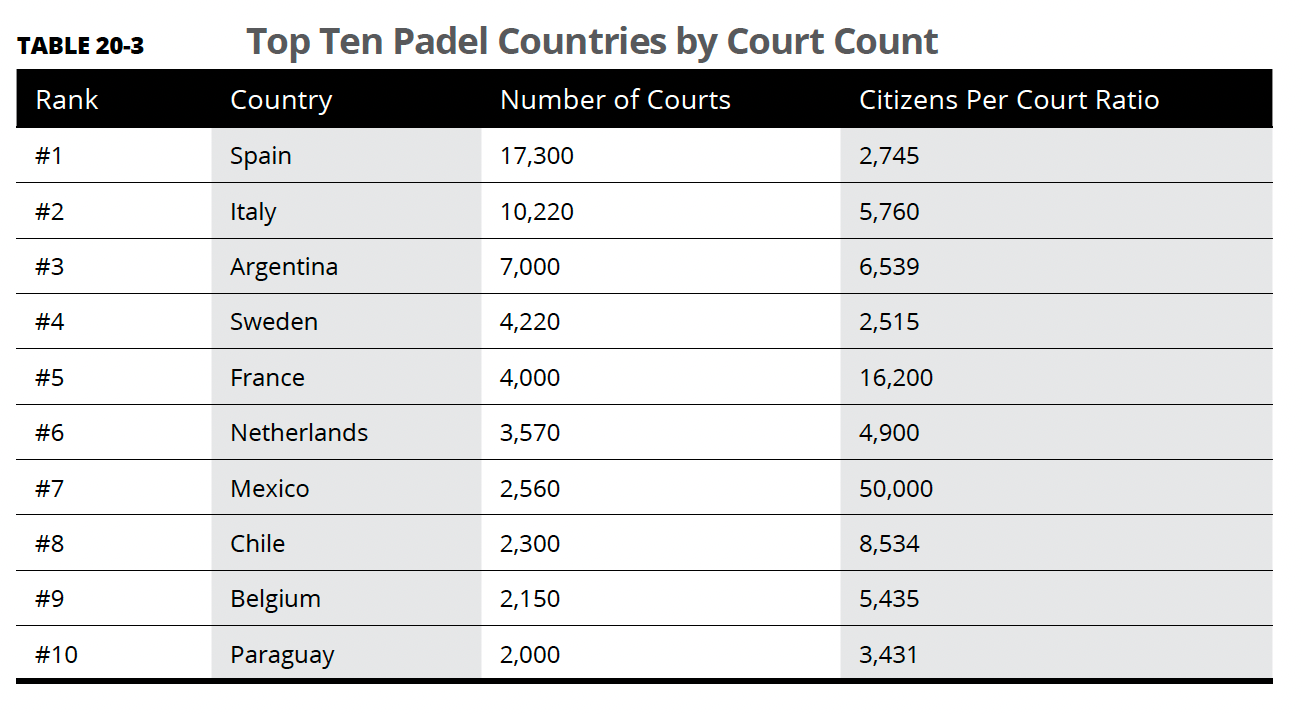
Given that the United Nations estimates that the U.S. currently has a population of roughly 349 million people, this means that, in theory, were padel to get as popular here as it is in:
Mexico, which the birthplace of the sport, we could support nearly 7,000 courts…
France, where the sport has exploded in popularity recently, we could support 21,500+ courts…
Argentina, which along with Spain has historically been padel’s primary stronghold, we could support about 54,375 courts…
Italy, which now is second only to Spain in total number of courts, we could support over 60,500 courts, or…
Spain, where the sport has grown and flourished for years, we could support a whopping 127,000+ courts (which is about 50,000 more than the number of pickleball courts currently in the U.S.).
To be clear, this is not a prediction of how many courts we might one day have in the U.S., but merely an extrapolation of how many courts we could potentially expect to have were padel to take off in the U.S. to the degree it has in other more mature markets.
Stockholm Syndrome
Of course, when it comes to cautionary tales in the padel world, none loom larger than the major market collapse (or perhaps correction, depending on how you look at it) that occurred in Sweden a few years back, which completely wiped out over 100 clubs and other padel-related businesses and resulted in an estimated €500 million in capital losses.
While exact data is somewhat hard to come by, the numbers I’ve seen seem to suggest that Sweden peaked somewhere in the general ballpark of 5,000 total courts before things started to go south, which would imply a citizens per court ratio of roughly 2,125.
Granted, several factors — including soaring energy costs — contributed to the massive market pullback in Sweden. But if we were to take this 2,125 ratio as a warning sign, it would mean that you’d need to start worrying about market (over)saturation at:
Around 1,250 courts in the greater Austin, TX metro area, where new padel clubs are starting to pop up left and right…
Roughly 1,400 courts for the greater Salt Lake City area (including Provo and Orem), which is experiencing a major padel boom at the moment…
Approximately 3,000 courts for the greater Miami metro area, which is undeniably the epicenter of padel in the U.S. right now…
About 3,700 courts for the greater Houston area (including The Woodlands), which is making a solid push to be padel’s “second city” in the U.S. after Miami, and…
Just over 6,000 courts for the greater Los Angeles area, where big new clubs are opening soon from leading operators including L.A. Padel Club, Ballers, and Bay Padel.
The Cost Discount and Pickleball Premium
Given that booking a padel court in the U.S. can easily be anywhere between two and ten-times more expensive than booking a court in places like Spain or Sweden, my guess is that the numbers above are overstated by a corresponding factor.
What’s more, unlike in those places, a significant portion of padel’s target addressable market is likely already playing pickleball instead of (or perhaps in addition to) padel here in the U.S., which will likely further reduce demand for courts.
So, while not scientific, unless padel somehow becomes significantly cheaper to play here in the U.S. or city parks around the country begin putting up hundreds of free courts, my approach on determining a rough U.S. saturation point would be to:
Apply Sweden’s 2125 “danger ratio” to the U.S. population — which works out to about 164,000 courts…
Divide this by three or four to account for the significant cost disparities between U.S. and European markets — which comes out to about 54,750 or 41,000 respectively, and…
Multiply this by somewhere between 0.75 and 0.50 to account for the percentage drop-off in demand due to pickleball (which I’d estimate between 25% and 50%)…
Which ultimately leaves you with about 41,000 courts on the high end and 20,500 on the low end.
Granted, I know those numbers will no doubt seem impossibly high to some (including me) and insultingly low to others (including everyone pushing the whole “We’ll have 20,000 courts in the U.S. by 2030” narrative on social media).
But, keep in mind, we only very recently even passed the 1,000-court mark here in the U.S., and in order for us to hit 20,000 courts by 2030, roughly 15 new courts would have to open every single day for the next 1,316 days straight (and unless 30 new courts opened this past weekend alone, we’re already behind pace!).
What’s more, even if 250 new courts opened every single month from here on out, it would still take over 13 years to hit the 41,000 court mark.
So, while I’m definitely bullish on the sport overall in the U.S. and happy to do whatever I can to help it grow, if I had to bet on these numbers, I’d definitely take the under.
Agree? Disagree? Please let us know in the comments below and/or vote in our poll:
Please also be sure to subscribe to Padel Nation (for free!) to get exciting updates and important insights on the rapidly emerging U.S. padel scene like this one delivered directly to your inbox 2X weekly — or share it with a padel-playing friend.
Finally, as always, a big thank you to the friends and preferred partners of Padel Nation who help make posts like this possible, including:


Interested in becoming a friend or preferred partner of Padel Nation? Drop us a line here and let’s talk!
Oh, and one other thing… I’ve actually got a full-blown padel book coming out in July. So, if you enjoy the work I’m doing in the U.S. padel space, you can support me by pre-ordering a copy (or two!) online at Amazon or Barnes & Noble. Many thanks in advance.
Finally got the chance to go through this. Thank you 1000x - a realistic, educated article like this has been much needed, especially to combat these pump-and-dump slop takes that have zero quantitative analysis behind them
A great look using realistic industry numbers. The new-courts-per-day is a great metric to keep things in perspective. Unlikely to see many padel courts in the municipal sphere - unlike in pickleball.