



Thanks to the influence of my proudly luddite father (who never owned a computer or a cell phone before he passed in 2020 — yet inexplicably loved his fax machine to the very end), I tend to be a bit of a technophobe myself.
What’s more, as I point out in the “Top 10 Reasons to Play Padel” chapter of my upcoming book, one of the things I personally love most about the sport is that it’s a refreshingly “analog” experience in what’s now an almost entirely digital world.
In fact, other than sleep, the hour or two I spend on a padel (or squash) court three or four times a week is about only time that that I’m not staring at a screen of one variety or another on any given day and actually being present in the moment.
And, to be honest, the last thing I want when I step off court is to instantly be shown AI-generated video highlights of how poorly I’m playing or get AI-driven coaching tips about how to improve my obviously mediocre game.
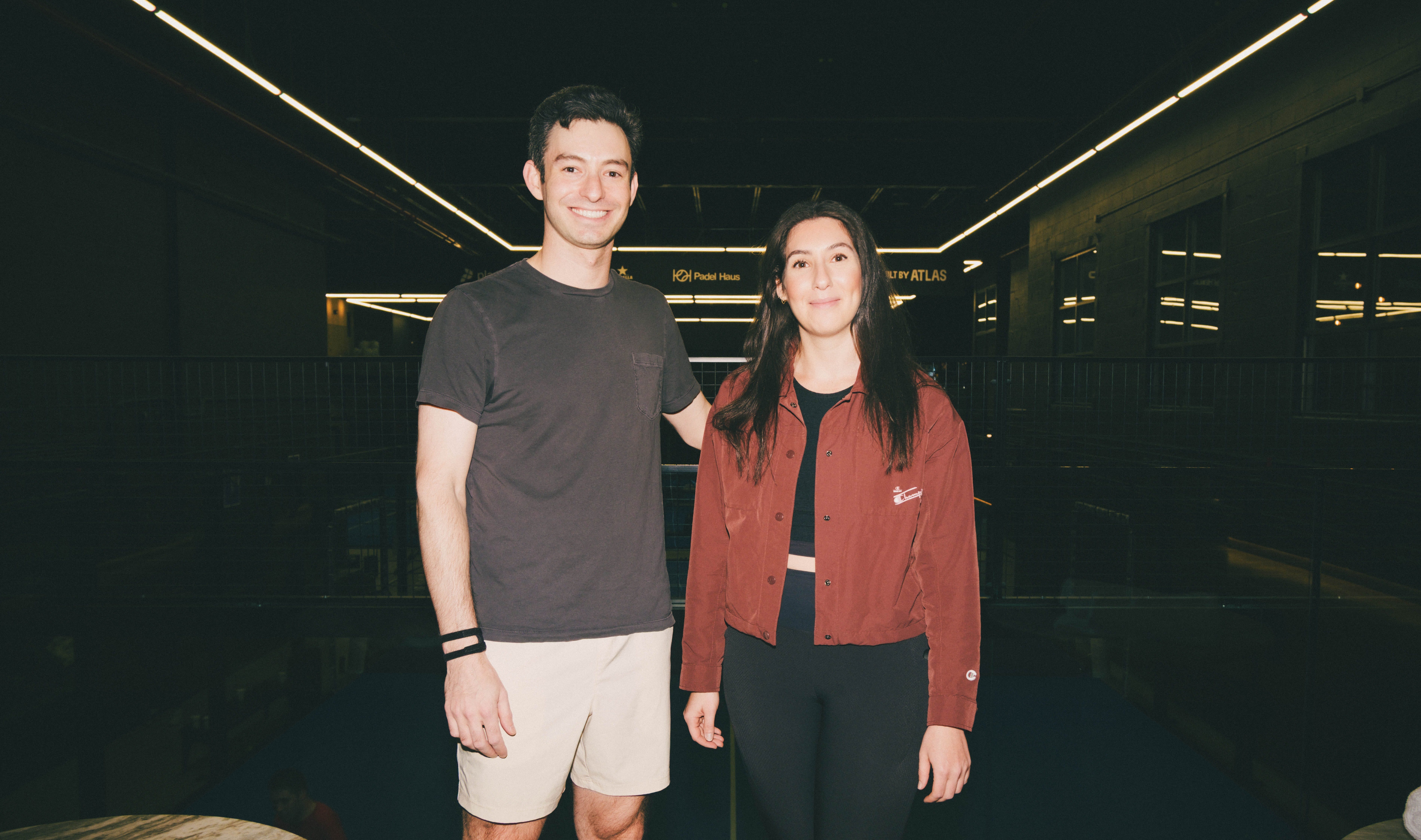
So, suffice it to say, as genuinely nice and obviously brilliant as they are, I was a little bit skeptical to hear about Julia Schwartz and Russell Einbinder’s plans for using AI to forever transform how we play padel. But I decided to hear them out…


The Path to Padel
The first thing that endears Julia and Russell to me when I first talk to them is that, unlike some other people I’ve come across in the padel space, they obviously love the sport itself and not just the upside potential they see in it.
Both grew up as tennis players, with Julia jokingly telling me she exited her career on a high note after she was the captain of her JV tennis team in high school. She also seriously brags on Russell and the fact that he was part of an NCAA championship-winning D3 tennis tennis team at Amherst (a fact he’s never once brought up to me, which is no surprise given his quiet, humble nature).
Both also discovered padel while living and working in New York City and almost immediately became obsessed. Julia informs me:
We’re both members at Padel Haus Dumbo in Brooklyn, so that’s our home base. It has been really special for us because it’s where we got hooked and where we’ve experienced firsthand how powerful the community side of the sport can be.
We’ve also been playing increasingly at Mink Padel (shoutout to Evan Brown!) now that the weather is warming up.
She goes on to tell me:
For Russell, padel has been a wild trip down memory lane, because he has reconnected with so many tennis players he grew up with on the USTA tennis circuit that he hasn’t seen since juniors.
He plays tournaments with his college doubles partner which has been an interesting arc in their competitive racquet sports journey.
Russell plays much more competitively and is regularly playing matches and tournaments, [whereas I’m] more on the social/open-play side — high beginner, aggressively campaigning for intermediate status, but very proud of my three wins at Monday’s high-beginner open play.
Once I’m convinced these two are far more padel-obsessed than they are padel opportunists, my mind opens a bit more to what they’re trying to do.

Solving Padel’s Many Pain Points
In order to understand where they are trying to go, I first ask about where they’ve been, to which Julia tells me:
We both come from pretty multidisciplinary backgrounds, which has ended up being really useful for building in a category like padel.
Before tech, Russell trained as an architect, earned his Master of Architecture from Columbia, and worked on a number of city and state buildings for New York and New Jersey. He then moved into startups and became Chief Growth Officer at Everyrealm.
I started my career in finance, having spent six-plus years in private equity before moving into startups and operating roles at early stage companies and finally Everyrealm, an a16z-backed blockchain and gaming company where I was a co-founder and Chief Strategy Officer.
Together at Everyrealm, we launched over 10 products, built communities into the hundreds of thousands, and managed large teams across engineering, product, marketing, and operations.
More recently, they’ve joined forces to start Unprompted, an AI product studio building custom agents and software products — which is where padel comes into the mix. As Julia explains:
We found our way into padel tech very organically. We became obsessed with the sport as players, and then immediately ran into all the same problems everyone else does: where can we play, how do we find people, what’s happening nearby, why is everything spread across WhatsApp threads, club websites, booking apps, and word of mouth? Padel Browser came from wanting to solve our own problems first.

Granted, I’ll likely always default to my very own low-tech U.S. padel map, which I created because I was finding so many AI-dependent sites giving out information like that the best place to play padel in the province (!) of Delaware is Houston, TX or that Lubbock, TX is home to nine different padel clubs, when it actually currently is home to zero.
But I have found it to be a very useful cross-referencing tool, and as they themselves point out, Padel Browser is far more than just a club-finding tool:
The North Star has always been simple: help more people play more padel.
Padel Browser started as a response to a basic discovery problem. When we got into the sport, it was surprisingly hard to answer simple questions: Where can I play? What clubs exist? What events are happening? What competitions are coming up? How do I get more involved?
So we started by mapping clubs and courts. From there, we expanded into competitions, programming, and events, and we’re now starting to build more around players and community.
Because discovery in padel is not just about finding a court. It is about understanding the whole ecosystem: where to play, who to play with, what is happening, and how to get involved. That is also a big reason we partnered with the USA Padel (formerly the United States Padel Association).

Taking the Next Step On- and Off-Court
They continue by telling me:
As we spent more time talking to players and working with clubs, we realized discovery is only the first step.
Once someone is interested in padel, there is still a lot of coordination required to turn that interest into actual participation. Players need help finding the right club, clinic, event, level, or group. Clubs need help capturing that demand, following up, filling programming, coordinating members, and making sure people find the right entry point. That is where our Front Desk Agents come in.
Padel Browser helps people discover the ecosystem. The agents help clubs activate that interest – by following up with leads, communicating directly with players, filling clinics and open plays, coordinating games between players at the right levels, and helping clubs run more proactively.
Having always been more of a visual learner, I ask them if they can show me what they’ve built rather than just tell me about it — and this is what they share with me:
While the tech behind all of this is admittedly all way over my head, I do start to see how this could also make life easier for players (and clubs alike) —especially as someone who has been constantly tasked with herding all the cats onto both the padel and doubles squash court over the years.
As they explain:
The biggest pain point is finding more people you can play with, so that you can play padel when you want, where you want, and with people at your level.
Padel has this funny paradox where the sport is incredibly social, but organizing a game can be surprisingly hard. You need four people, ideally at roughly the same level, in the same geography, with overlapping availability, who are all looking for the same kind of experience.
That’s a lot of coordination for something that should feel easy and fun. Right now, most of that coordination happens manually. Players text friends, post in WhatsApp groups, make open games on booking apps, wait for someone else to organize, or default to playing with the same three people.
Clubs also spend a lot of time trying to fill courts, organize open plays, match players by level, and answer repetitive questions.
So for us, the core problem is not just ‘booking’ or ‘discovery.’ It’s coordination. If we can make it easier for players to find the right games and easier for clubs to activate their communities, we think that directly grows participation (and retention for clubs, too).
After a half-dozen conversations with this fast-moving duo over the past few months, I’d venture to guess that this is just one of many AI-fueled, padel-focused innovations we’ll see from them going forward.
And, at the end of the day, I’m all for any technology that helps grow the sport and makes it easier for me to get on court — if only so I can get away from technology for a little while.
If you enjoyed this article, please be sure to subscribe to Padel Nation (for free!) to get exciting updates and important insights on the rapidly emerging U.S. padel scene like this one delivered directly to your inbox 2X weekly — or share it with a padel-playing friend.
Finally, as always, a big thank you to the friends and preferred partners of Padel Nation who help make posts like this possible, including:


Interested in becoming a friend or preferred partner of Padel Nation? Drop us a line here and let’s talk!
Oh, and one other thing… I’ve actually got a full-blown padel book coming out in July. So, if you enjoy the work I’m doing in the U.S. padel space, you can support me by pre-ordering a copy (or two!) online at Amazon or Barnes & Noble. Many thanks in advance!