


Editor’s Note: The following post is a (slightly edited) excerpt of an article penned by guest author Scott Matulis, a long-time public relations pro who was once the PR Director for the Worldwide Senior Tennis Tour. He discovered padel in Las Vegas in 2024 and can now hit balls off of the glass occasionally. He is the author of the LinkedIn and Substack serial novel The Applicant.
Also of note: For the third strait year, P1 Padel will be hosting the Playbypoint Las Vegas Open this April 24 - 25 — which is a USPA 2000 level tournament with a $25,000 total prize pool.
I moved to Las Vegas in April of 2024 for a job. And, like a lot of tennis players who suddenly find themselves in a new city, the first thing I did was start driving around looking for courts.
One afternoon I was cruising down Buffalo looking for the All-American Tennis Club when I noticed several glass-walled padel courts that looked vaguely familiar.
“Man,” I thought, “I’ve seen that on YouTube. Those guys are nuts.” Also: “I could totally do that.”
I pulled into the parking lot and walked inside to check it out.
One of the staff members gave me a quick introduction to the sport and signed me up for an entry-level round-robin event called “Courts and Coffee” that the club holds every Sunday morning.
He was a tennis player, too. Padel, he explained, was a great landing spot for aging tennis players like me who still wanted to compete but weren’t particularly jacked about the wear and tear of hard courts or chasing drop shots into the doubles alley. I’ve had both my knees replaced so that sounded good to me.
The next morning I showed up and put the hammer to a fair number of beginners who had not spent the last 50 years hitting tennis, pickle, and racquet balls. About 25 of us played a four-round, 90-minute Americano format tournament. Courts and teams reshuffled every twenty minutes, giving me the chance to meet just about everybody.
No pressure. No USTA-league-type weirdness. Just people playing, socializing and having a good time.


Almost two years later, I’ve got a place to spend several nights a week with an ever-increasing group of friends from all over the world — some of whom have been playing padel most of their lives, and some of whom, like me, discovered padel in the middle of the desert.
Actually, almost none of them are like me. Meaning: an aging American tennis player from the suburbs of Southern California. The only two I’ve met are Casey from San Diego and John, who oddly enough grew up a mile away from me and played tennis for a rival high school in my hometown (who I will say we crushed regularly).
The three of us share two things: a love of padel and a love of half-priced drinks at the Rustic House after a three-set match.
Most nights though, I’m the only American on the court or at the table. Which has forced me to confront the fact that my flippant attitude toward high school Spanish was a huge mistake. Even though I grew up in SoCal, I thought, “who am I ever going to meet that speaks Spanish?”
Now just about everybody I meet speaks Spanish. And even though I am sure my friends from Argentina, Spain, and Brazil are goofing on me, I have absolutely no idea what they’re saying.
But the Real Secret of Padel Isn’t the Sport Itself — It’s the Community It Creates
In 1989, American sociologist Ray Oldenburg introduced the concept of the “third place” in his book The Great Good Place.
A third place is a gathering spot separate from home and work where people can relax, build friendships, exchange ideas and feel part of something bigger than themselves. A place where everybody knows your name.
Think neighborhood pubs, coffee shops, barber shops and “Norm!” A lot of them — Elks clubs, the general store, the soda fountain, and the pool hall — are not nearly as popular as they used to be. But people still need a place to unwind.
I’m a huge believer in the need for a third place, especially now that I live in a whole new town.
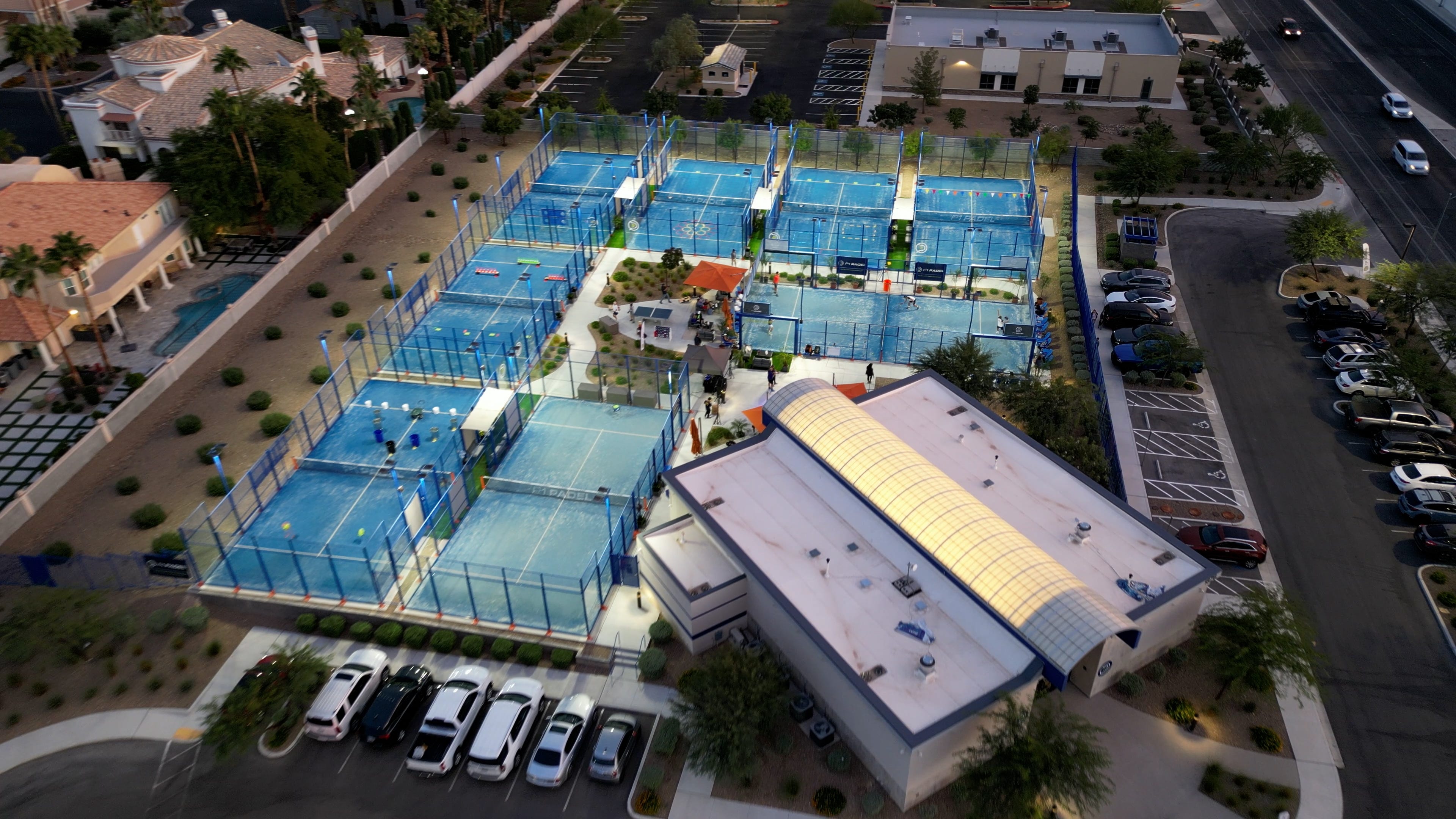
P1 Padel in Las Vegas is exactly that.
The People
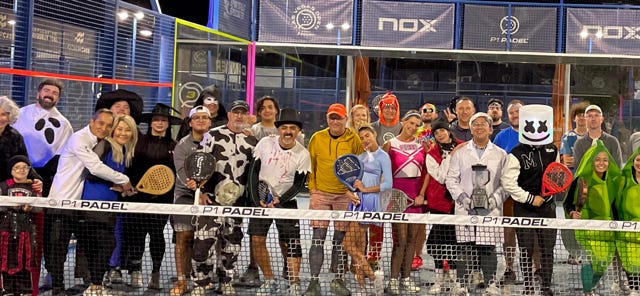
The first thing you notice about P1 is the mix of people.
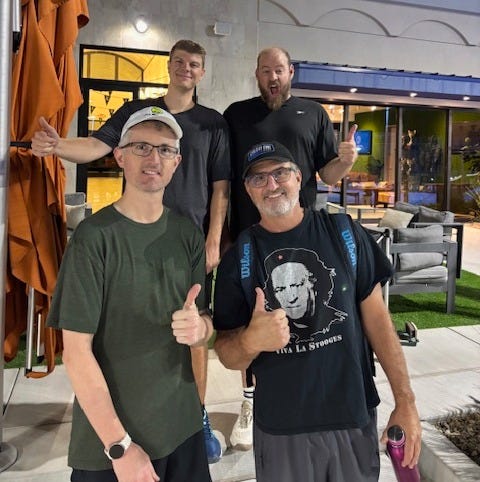
My regular playing group includes players named Pablo, Jorge, Chava, Casey, Alex, Sarah, Michael Smith and Zoltan, as well as more Scotts than I’ve met in my entire life.
Zoltan is from Hungary. He and his childhood friend Daniel came to the United States to play college soccer. Neither of them had ever picked up a racquet before discovering padel. Neither had Alex from England. Now all three of them can hang with anybody at the club.
There’s a picture on my phone of me with Zoltan’s mom that he took of us when she came to visit him. I also have a photo with Chava’s grandmother and sister when they came to town a few months ago.
Pablo is from Argentina. Chava’s family lives in Tijuana. Sarah is from the Philippines, teaches special education and goes on padel trips around the world.
Mo is from Lebanon. He worked at the Wynn and was recently relocated to London to help open a casino there. Parisa brought me ice cream after my latest knee surgery.
The next day, Michael Smith — we all call him Michael Smith, never Michael — brought me Tylenol and kept me company before he moved back to Australia.
It’s a great group. And they’re pretty representative of the clientele at P1 regardless of the level of padel they play. No attitude. No “I was ranked number 45 alphabetically in the fourteen-and-unders.” No “our USTA team went to sectionals, so you’re going to have to earn a spot.”
Just people who like to go at it and get better.
The Origins of P1
The club itself was built by an affable English guy named Martin Sweeney who discovered padel when he moved from the U.K. to Spain in 2009. At the time, he was a squash player but quickly realized that in Spain it was much easier to book a padel court than a squash court.
Sweeney explains:
“Like many of us, I immediately became addicted to padel. In 2011, I moved to Dubai and discovered that there was no padel in the Middle East so I decided as a bit of a passion/ hobby to open three courts at Emirates Golf Club.
That facility continues to operate and now has 20 courts. We originally had to call our sport ‘paddle tennis’ as the word ‘padel’ was already under copyright in Dubai.
Real Racquet Academy was born in 2013. I named the club Real Racquet Academy in recognition of the location where I first played padel, which was Real Club, Marbella.”
The Las Vegas club helped put the United States on the padel map. According to Sweeney it was the first purpose-built padel facility in the country and only the seventh club nationally when it opened in 2019.
In 2022, Real Racquet Academy hosted the Seniors Padel World Championships, welcoming 450 players from 16 countries.


Sweeney eventually leased the club to escape-room entrepreneur Simon Davison, who renamed it P1 Padel in 2023. Sweeney still owns the club and plays doubles with our advanced men’s group Sunday mornings.
The Engine of the Community
While the courts draw people in, the community exists largely because of the people running the club.
General Manager Phil Martinez, along with his girlfriend and co-GM Codi Hollomon and a rotating crew of young guys named Jake, Tommy, Anthony and Mane, run the show and make everybody feel at home. All of them know your name.
Phil is the nerve center of the operation — organizing tournaments, running leagues, managing logistics and acting as a conduit between members and ownership. He’ll also fill in if somebody cancels at the last minute, which hardly anybody ever does.
Neither Phil, Codi or any of the other club employees had played tennis or any racquet sport before discovering padel.
But they all play well now, which tells you something about the sport’s learning curve and the fact that they all like being at P1 as much as everybody else does.
The Funnel
P1 has developed a really effective funnel for bringing new people into the community.
The first entry point is often “Courts and Coffee”, the Sunday round-robin that hooked me. Another popular option is “Try Padel”, a one-hour introductory session led by one of the coaches.
For ten bucks newcomers get an hour-long intro to the rules, basic tactics and the social rhythm of the game. Afterward there’s coffee. People usually stick around to watch matches and feel the vibe.
That’s how my friend Michael Smith got started. An Australian who flies planes for Spirit Airlines, he saw ads for P1 on Instagram and decided to give the sport a try.
As Michael Smith remembers it:
“Coach Jeff went through some basic drills and pretty quickly realized I’d played racquet sports before and could hit the ball, so he gave me a little bit more of an in-depth introduction.
He put me in touch with a few guys who were reasonable players that played mornings and I played some social matches with them. From there I started to play men’s night on Monday nights and then signed up for Club Night on Wednesdays and sort of from there decided to improve.
I got to meet some people and find people of a similar level who were available at similar times and started arranging matches.”
Much later, after he was already much improved, he was laid off and started spending most of his waking hours at the club. Granted, he’s a tennis player, but over six months or so he turned himself into arguably the best over-40 player at P1 and started beating the daylights out of the rest of us. He also lost 40 pounds doing it.
“Being newish to America, and certainly new to Vegas, padel became my circle of friends, really, outside of work,” Michael Smith tells me. “Those are the people I know from Vegas.”

The Rhythm of the Club
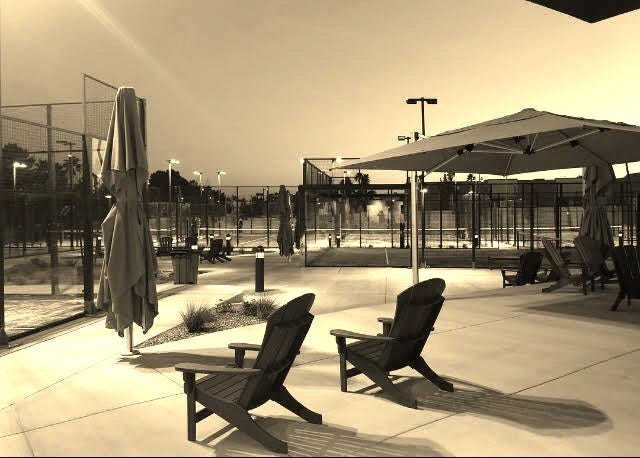
Most nights the social center of the club isn’t the clubhouse — it’s the patio outside the courts. Players hang around after matches drinking sports drinks, talking trash, and waiting for the next round of games.
There’s a small kitchen serving smoothies and pizza (the smoothies are excellent, Jake’s still trying to get the hang of making the pizza).
Because the club sits next to a Methodist church and a high-end residential neighborhood P1 doesn’t have a liquor license, so if we want a post-match cocktail, we hit the Rustic House.
Still, the club regularly hosts birthday parties, barbecues, leagues and special events hosted and staffed mostly by the players.
As you can imagine, Las Vegas attracts a lot of out-of-town celebrities and a fair amount of them end up on the P1 courts.
According to Hollomon, actor Woody Harrelson has played here. So has DJ Martin Garrix. Formula One drivers — including Pierre Gasly and Lance Stroll — have stopped by.
I once played on the court next to the Prince of Qatar.
Even if you’re not a celebrity, if you find yourself in Las Vegas, Phil and Codi can arrange matches for you while you’re here.
Why It Matters
In her book Daring Greatly, Brené Brown writes: “Connection is why we’re here; it is what gives purpose and meaning to our lives.”
In one of his essays, Desmond Tutu says something similar:
“A person is a person through other persons. We need other human beings for us to learn how to be human, for none of us comes fully formed into the world.”
I’ve found both ideas to be true.
Ray Oldenburg called places where people find community third places.
I call it Club Night at P1 Padel.
You can visit P1 Padel at 1876 S Buffalo Dr, Las Vegas, NV 89117 between 7am and 11pm on weekdays and 7am and 9:30pm on weekends. You can call the club at (702) 575-1700 or book a court via their website.
Enjoy this article?
If so, please be sure to subscribe to Padel Nation to get exciting updates and important insights on the rapidly emerging U.S. padel scene delivered directly to your inbox — or share it with a padel-playing friend.
Finally, as always, a big thank you to the friends and preferred partners of Padel Nation who help make posts like this possible, including:


Interested in becoming a friend or preferred partner of Padel Nation? Drop us a line here and let’s talk!
Oh, and one other thing… I’ve actually got a full-blown padel book coming out in July. So, if you enjoy the work I’m doing in the U.S. padel space, you can support me by pre-ordering a copy (or two!) online at Amazon or Barnes & Noble. Many thanks in advance!